Running a truck has never cost more. In 2025 the American Transportation Research Institute (ATRI) reported the industry-average cost-per-mile at $2.34 per mile, up 3.4% from the year before and the highest in the report’s history. Fuel was about a fifth of that.
What carriers kept was almost nothing. In the truckload and refrigerated sectors, operating margins came in below 1%, meaning less than a penny of profit on every dollar of revenue. Only less-than-truckload (LTL) carriers and fleets running more than 1,000 trucks held healthy margins.
Here’s why that’s worth your attention. Savings on fuel don’t require a new customer, another truck, or another driver. There’s no invoice to chase and no additional risk to carry. Lower what you pay for diesel and the money lands on your bottom line more directly than the same dollar earned hauling freight.
Fuel Is One Expense You Can Actually Influence
Most of what it costs to run a truck is set by somebody else. Your truck payment and insurance premium are largely fixed, and tolls cost what they cost.
Fuel is different. You buy it week after week, and every one of those purchases is a decision. What you pay depends on how you run the operation.
There are three levers behind any fleet fuel management strategy: where you buy, how you plan for it, and how much you burn. This article covers the first two, because they cost nothing to change and they start working on your next load. For the third, see our guide to improving semi-truck fuel economy.
Cents Per Gallon and Cost Per Mile: What Each One Tells You
Cents per gallon is what you pay at the stop. Cost per mile is what that saving does to your operation. Both matter, and each answers a different question.
Cents per gallon is how you choose one truck stop over another when you plan a route. Cost per mile is the number you refer to when you are pricing a potential load for a customer. Getting from one to the other takes one step:
Price Per Gallon ÷ Miles Per Gallon (MPG) = Fuel Cost Per Mile
To calculate that yourself, use what you paid on your last fill, divide it by your MPG, and you have your fuel cost per mile at that price.
The saving works the same way, except the pump price drops out entirely:
Discount Per Gallon ÷ Miles Per Gallon (MPG) = Savings Per Mile
The TCS Fuel discount average is 49¢ a gallon discount* and 7.43 MPG, (the national truck-tractor average in ATRI’s latest report), that comes to roughly 8 cents a mile. Whether diesel is running high or low, that 8 cents holds.
Example
At An Average
49¢
Discount*

49¢
discount per gallon
÷

7.43 MPG
per truck average

$0.08
saved per mile
Eight cents on every mile you were already going to run. Same trucks, same freight, same drivers. You just paid less for the fuel.
Remember, fuel cost per mile is only the fuel. Your total cost per mile (CPM) includes the truck payment, insurance, maintenance, tires, and driver pay. Fuel is one line in that total, and one of the few you can actually lower.
What That Looks Like Over a Year
A truck running roughly 85,991 miles a year at 7.43 MPG burns about 11,600 gallons of diesel. At a discount of 49¢ a gallon, that works out to around $6,800 a year from a single truck, or about $570 a month.
Scale it across a small fleet:
| Trucks | Estimated annual savings |
|---|---|
| 1 | ~$6,800 |
| 5 | ~$34,100 |
| 15 | ~$102,400 |
| 25 | ~$170,700 |
These are estimates built on stated assumptions: 85,991 miles a year, 7.43 MPG, and an average in-network discount of 49¢ a gallon*. Your numbers will be different, your mileage, your fuel economy, and your routes will all adjust the total.
See How Much You Could Save on Fuel
The Best Savings Come from Planning, Not from Reacting
Chasing the cheapest price on the truck stop sign isn’t a winning fuel strategy. It leads to rushed decisions, out-of-route miles, and stops that don’t have the amenities your driver needs. The real money is saved by deciding where to fuel before the truck is on the road.
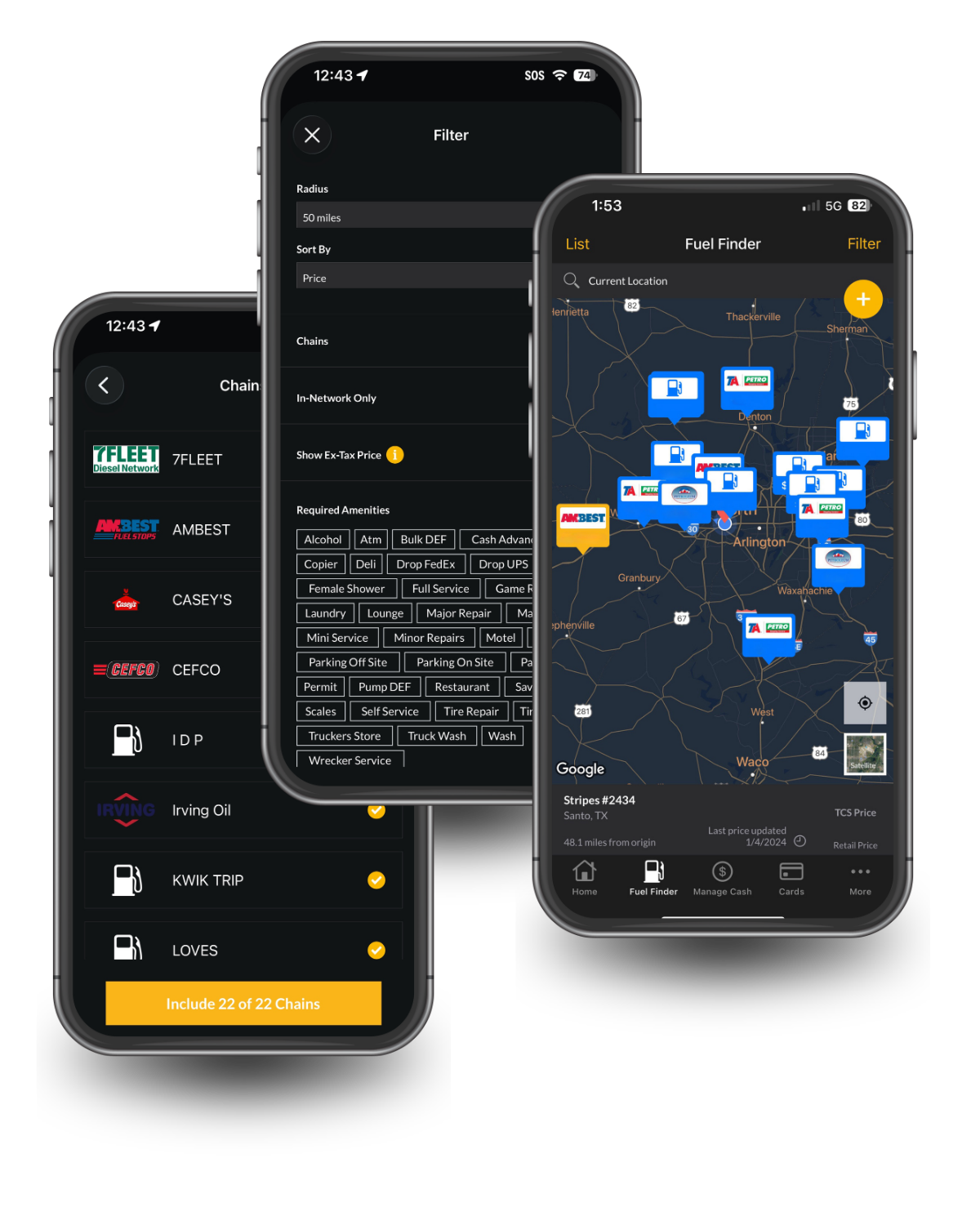
 Plan the whole route, not just the next stop. The TCS Fuel Finder, available in the TCS Mobile App and the TCS website, lets you search by current location, city, ZIP, or planned route and compare stops before you turn the key.
Filter for what the driver needs. Parking, showers, scales, DEF, food, maintenance. A stop that has the discount and the amenities is a stop your driver will actually use.
Watch the miles, not just the price. Detouring for a cheaper gallon can cost more in miles than it saves at the pump.
For a look at building this into your operation, see Smart Fuel Management.
In-Network Is Where the Discounts Live
As a fleet fuel card, the TCS Fuel Card is accepted at more than 12,000 locations nationwide. More than 2,300 of those are in-network stations, and that’s where the fuel discounts and $0 fuel transaction fees apply. Including TA®, Petro Stopping Centers®, TA Express®, AMBEST, and the 7FLEET Diesel Network, among others.
Discounts vary by location and geographic region, and they move as market conditions do. That’s exactly why planning and in-network fueling are part of the same habit rather than two separate ones. The TCS Fuel Finder shows which nearby in-network stops are offering the best discounts right now.
Across Several Drivers, Consistency Takes a System.
With the TCS Fuel Card, you can assign cards by driver or vehicle, set permissions by role, cap spending on fuel and non-fuel products and one-time cash, and require prompts at the pump for unit number, mileage, and driver number. Your dispatcher, bookkeeper, and owner can all work from the same numbers. For more on funding, controls, and reporting, see How Does a Fuel Card Work.
Also, fleet fuel tracking with the TCS Fuel Card gives you detailed, high-level views of your fuel activity over time, including what you bought in-network versus out-of-network and where savings were missed. Use it to find next month’s improvement.
You can’t set the price of diesel, but you do have choices on what you pay for it.
Prefer to talk beforehand? Give us a call at 844-827-7705.
*Average savings of 49 cents per gallon is based on actual in-network TCS client transactions from Q1-Q3 2026. Due to fuel price volatility, year-to-date average discounts are shown to provide the most representative view of client savings.